Showing posts with label Plants. Show all posts

By Deb Wiley
Fact 1:
Torenia, a shade-loving annual, is called the wishbone flower. Look for tiny wishbone-shape stamens inside the purple, blue or burgundy petals.
Fact 2
The world's tallest-growing tree is the coast redwood (Sequoia sempervirens), which grows along the Pacific Coast of the United States, mainly in California. Interestingly enough, it's not the world's oldest-growing tree; that award goes to a bristlecone pine (Pinus aristata).
Fact 3
Bamboo is the fastest-growing woody plant in the world; it can grow 35 inches in a single day.30 Fun Facts About Plants
Fact 4
Tomato juice is the official state beverage of Ohio, honoring the part A. W. Livingston of Reynoldsburg, Ohio, played in popularizing the tomato in the late 1800s.
Fact 5
Archaeologists have uncovered evidence that grapes were grown to make wine about 8,000 years ago in Mesopotamia (today's Iraq), although the ancient Egyptians were the first to record the process of making wine about 5,000 years ago.
Fact 6
During the 1600s, tulips were so valuable in Holland that their bulbs were worth more than gold. The craze was called tulip mania, or tulipomania, and caused the crash of the Dutch economy. Tulips can continue to grow as much as an inch per day after being cut.
Fact 7
Vanilla flavoring comes from the pod of an orchid, Vanilla planifolia. Though the pods are called vanilla beans, they're more closely related to corn than green beans.
Fact 8
The word pineapple.comes from European explorers who thought the fruit combined the look of a pinecone with flesh like that of an apple. Pineapples are the only edible members of the bromeliad family.
Fact 9
From a botanical standpoint, avocados and pumpkins are fruits, not vegetables, because they bear the plants' seeds. Rhubarb, on the other hand, is a vegetable.
Fact 10
Saffron, used as a flavoring in Mediterranean cooking, is harvested from the stigmas of a type of fall-blooming crocus, Crocus sativus.
Fact 11
Poinsettias, natives of Mexico, were brought to the United States in 1825 by the first U.S. minister to Mexico, Joel Poinsett, for whom the plant is named.
Fact 12
Small pockets of air inside cranberries cause them to bounce and float in water.
Fact 13
The flower of the titan arum (Amorphophallus titanium) is the largest unbranched flower in the world and can reach up to 15 feet tall. The bloom produces a smell like that of rotting meat, giving it the common name of corpse flower. A similar smell comes from Rafflesia, another plant that hails from the rain forests of Sumatra. Both plants developed their scent so they could be pollinated by flies; they don't compete with other blooms for butterflies and hummingbirds.
Fact 14
All parts of the oleander (Nerium oleander), a beautiful Mediterranean-native flowering shrub, are poisonous. Ingesting oleander leaves can cause gastrointestinal, cardiac, and central nervous system problems and possible death.
Fact 15
Iris means "rainbow" in Greek, and Iris was goddess of the rainbow in Greek mythology. Wormwood (Artemisia) was named after the goddess Artemis, milkweed (Asclepias) after the god Asclepius, and Hebe after the Greek goddess Hebe.
Fact 16
In France, May 1 is La Fete du Muguet, the festival of the lily-of-the-valley. The celebration includes giving bouquets of lily-of-the-valley to loved ones, wishing them health and happiness.
Fact 17
Angiosperm is the scientific name for flowering plants and refers to the seeds being borne in capsules or fruits. Nonflowering plants— pines, spruces, firs, junipers, larches, cycads, and ginkgoes— are called gymnosperms.
Fact 18
Snapdragon flowers resemble a dragon, and if you squeeze the sides, the dragon's mouth will appear to open and close.
Fact 19
A sunflower looks like one large flower, but each head is composed of hundreds of tiny flowers called florets, which ripen to become the seeds. This is the case for all plants in the sunflower family, including daisies, yarrow, goldenrod, asters, coreopsis, and bachelor's buttons.
Fact 20
The first potatoes were cultivated in Peru about 7,000 years ago.
Fact 21
Peaches, Pears, apricots, quinces, strawberries, and apples are members of the rose family. So are ornamental species such as spirea, mountain ash, goatsbeard, and ninebark.
Fact 22
Cranberries, Concord grapes, and blueberries are three popular fruits native to North America.
Fact 23
The difference between nectarines and peaches is that nectarines don't have fuzzy skins. You can graft peach branches onto a nectarine tree or nectarine branches onto a peach tree so you have both types of fruits.
Fact 24
The average strawberry has 200 seeds. It's the only fruit that bears its seeds on the outside.
Fact 25
Sulfuric compounds are to blame for cut onions bringing tears to your eyes. According to the National Onion Association, chilling the onion and cutting the root end last reduces the problem.
Fact 26
Garlic mustard is a member of the mustard family, not garlic. This invasive herb outcompetes native plants in the Eastern and Midwestern United States, posing a threat to other native plants and the species that depend on them.
Fact 27
Ginkgo (Ginkgo biloba) is one of the oldest living tree species; it dates back to about 250 million years ago. Dawn redwood (Metasequoia glyptostroboides) is another ancient species; it dates back about 150 million years. Both were known in the fossil record before they were found alive.
Fact 28
Trees are the longest-living organisms on earth.
Fact 29
Peanuts are not nuts, but legumes related to beans and lentils. They have more protein, niacin, folate, and phytosterols than any nut, according to the National Peanut Board.
Fact 30
The title for the world's hottest chili pepper remains contested. ‘Bhut Jolokia', 401.5 times hotter than bottled hot pepper sauce, earned the Guinness World Records title in 2007, but several hotter chilis claimed the title in 2011.
Source:Better Homes and Gardens

Friday, July 19, 2013 Stephen E. Doyle
Plants are beneficial to humans and other animals in a myriad ways. The most commonly thought of benefit, that plants provide, is that they give off oxygen while takingWhy Do Plants Need Light? in carbon dioxide. They, namely trees, also provide shade and cooler temperatures.
Plants are also used in manufacturing products such as paper, lighting, adhesives, medicine, clothing, cosmetics, fuel, charcoal as well as many other products. Additionally, plants provide food for people everywhere. But without light, plants- and life as we know it-  would cease to exist. All plants and animals are fully dependent on photosynthesis for their energy. While some carnivores do not eat plants, directly, the vast majority consume animals that subsist on plants. But why exactly do plants need light? How does this miracle process work?
“Plants need light for photosynthesis. Photosynthesis is the process of the plant making its own food,” said Matt Kostelnick, senior horticulturalist, at Ambius. Photosynthesis occurs within the chlorophyll inside the chloroplasts. Chloroplasts are the sites of photosynthesis. This is a two-step process: the light reactions and then the Calvin cycle.
The photosystems involved in the light reactions are: the ‘water-splitting photosystem’ in which electrons are extracted from water and oxygen is released onto the atmosphere. The second photosystem that takes place is what is referred to as the NADPH Photosystem, in which electrons are moved from the chlorophyll to NADP-producing NADPH. Together the two photosystems release energy to the chloroplast, which then uses it to drive cellular processes crucial for plant survival.Why Do Plants Need Light?
Inside the thick double-membraned layer of the chloroplast is a thick fluid called stroma and inside is an apparatus of stacked green sacs known as ‘grana.’ This is where the chloroplast molecules capture light energy. The energy from the light is utilized to produce ATP (adenosine triphosphate) as well as NADPH.
ATP is the cellular molecule that supplies cells with the energy to do work. NADPH is an electron carrier used in the calvin cycle where it transforms carbon dioxide into high energy sugar which, in turn, is used by cells to make glucose and other needed organic molecules. Alas, memories of high school biology class come flooding in while attempting to accurately recall all that was taught.
Kostelnick went on to explain that, “Plant leaves function a lot like ‘solar-panels,’ instead of creating energy, they are creating food for the plant by harnessing light energy from the sun (or another light source).”  Kostelnick’s easy to understand interpretation clearly defines the importance of the process utilized by plants and other organisms to convert light energy mainly from the sun, into chemical energy that will be used to fuel the organisms’ life-defining activities.
What other ways do plants benefit us? Share below in the comments.
Source: Ambius


Mineral deficiencies can cause plants to fail and show symptoms of “disease” (technically disorder), but in a well-ordered organic garden they are seldom a problem. When managed organically, most garden soils will provide all the nutrients plants require. Occasionally, especially in alkaline soil, trace elements, although present, may not be soluble due to the high ph, and are therefore unavailable to the plant. On these occasions, additional supplies might be needed. Mineral deficiencies can also be caused by too much of another element; overdo potassium-rich fertilizers, for example, and you may “lock up” magnesium so that plants develop symptoms of magnesium deficiency.
Mottling, marking, and even crisping of leaves can all be the result of mineral deficiencies. fruits may also spoil and wither. however, mineral deficiencies are often difficult to confirm from symptoms alone and can easily be confused with diseases, especially viruses.  If a problem persists, it may be necessary to have the soil analyzed professionally
1 Iron deficiency is one of the most common plant disorders and almost always presents as a yellowing of leaves, especially between the veins. It is particularly common in alkaline soil, when it is known as lime-induced chlorosis.
2 Manganese deficiency (on potato leaves), common in poorly drained soil.
3 Phosphorus deficiency (on tomato leaves), often seen in acidic soil.
4 Potassium deficiency (on string beans), often seen in light or sandy soil.
5 Bitter pit in apples, caused by calcium deficiency, also common in light, sandy soil.
6 Boron deficiency on sweet corn; over liming can disrupt the uptake by plants of this trace element
www.agrinfobank.com

www.agrinfobank.com


Continue to dig over existing beds and borders, again incorporating as much organic matter as you can. Forking over not only helps prepare the soil for spring, it helps reduce pests by exposing them to hungry birds.

Although temperatures should start to rise this month, there is still a risk of frost and even snow. Protect vulnerable plants, pots and taps from frost by wrapping insulation such as garden fleece around them and check pots and containers are raised off the ground if possible. Tender trees and shrubs will thank you for a generous application of dry mulch to protect their roots from freezing conditions.

Once the ground isn’t frozen, make new beds and borders - mark the shape with sand trickled from a bottle, remove the top layer of growing vegetation and dig the ground over, incorporating as much organic matter as possible. If you are making a bed in the lawn, remove the turf and stack it upside down somewhere out of the way - after a year or two it will rot down into fantastic compost. Alternatively chop it up and bury upside down in the planting hole a good spade’s depth down. Beware - if you just dig it in the buried grass will regrow and regrow and regrow and...

Remember not to let leaves accumulate around alpines - they will die if left damp for long. Cover bare patches around clumps with gritty compost to encourage regrowth. When the weather allows, carry on clearing paths, check walls (but avoid concreting until there is no chance of frost), clean and insulate greenhouses and ensure heaters are working properly. Even a little insulation will make a huge difference to your heating bill.
Clean and repair your garden tools, book the lawn mower in for a service and check garden furniture for any rot. When it is warm enough, treat sheds, fences and trellis with wood preservative; brushes and rollers are fine for most things, however a sprayer is well worth buying for tricky projects such as woven panels!


Source of Article: http://www.thegardencentregroup.co.uk/


If a seed is lucky, it will land on good soil. When the conditions are right, it may grow into a new plant. This is called germination. Seeds contain their own energy store.

They do not need light at first. But they do need  water, warm temperatures, and oxygen. If a seed has the right conditions, it grows a root. The root pushes down  into the soil. Then it grows a shoot. The shoot pushes up  through the soil. When it reaches the air, its new leaves uncurl. At this point, the seed can use its leaves to trap energy from the Sun. It does not need its own energy store any more. Now, it carries out photosynthesis. This will help it grow into a strong, full-grown plant.


Hydroponics - a quick overview

Truly a wonder of modern science - hydroponic gardens produce bountiful harvests of fruit, vegetables, grains, herbs and flowers in places never before able to sustain growth. Hydroponic gardens produce the healthiest crops with the highest yields and vitamin content thanks to their perfectly balanced nutrient solutions. Modern hydroponic methods provide food for millions of people worldwide and supply you, me and the food service industry with superior produce. In fact, hydroponic cultivation is so effective, NASA has devised an advanced method of hydroponics for use in outer space. The science of hydroponics began with experimentation into deter-mining the elementary composition of plants. These experiments have been dated as early as 1600 A.D., however, records show that plants have been cultivated in soil free mixtures of sand and gravel even earlier. The hanging gardens of Babylon and the floating gardens of the Mexican Aztecs are perfect examples of early hydroponic gardening. Egyptian hieroglyphics have even been found depicting the cultivation of plants in water as far back as several hundred years BC.

The word "Hydroponics" was coined by Dr. W.F. Gericke in 1936 to describe the cultivation of both edible and ornamental plants in a solution of water and dissolved nutrients.

The simple meaning is derived from the Greek "Hydro"- meaning water, and "Ponos"- meaning labor.

In this method of cultivation, plants are provided with the nutrients required for growth by a “nutrient” solution which is basically nutrient enriched mineral water. This nutrient solution can be circulated around the roots by either the passive force of gravity or the active force of an electromechanical pump. Some systems simply bath the roots in nutrient solution and use an air pump to oxygenate the solution from below to prevent stagnation and provide the roots with important oxygen.

Plants grown hydroponically are healthier than their soil grown counterparts since they receive a perfectly balanced diet and do not come in contact with soilborne pests and diseases. Super efficient hydroponic systems like the ones we show you how to build conserve water and nutrients by preventing evaporation and runoff. Arid regions where water is scarce can now grow crops with hydroponics. Since hydroponic systems deliver water and nutrients directly to the plant, crops can be grown closer together without starving each other and healthier plants add to a higher yield. By growing crops in a sterile environment, under ideal conditions, hydroponics saves the costs of soil preparation, insecticides, fungicides and losses due to drought and ground flooding.

In soil, plants waste a tremendous amount of energy developing a large root system to search for moisture and nutrients. When grown hydroponically, the roots are bathed or sprayed with nutrients dissolved in water. This way their energy can be redirected into the production of more foliage, flowers, fruits and vegetables.

Plants grown hydroponically are healthier because they receive a well balanced 'DIET'. They are more vigorous because little energy is wasted searching for water and nutrients. As a result, hydroponically grown produce is generally larger, tastier, and more nutritious than the same produce grown in soil. In order to give the physical support soil would normally provide, a sterile medium such as sand, gravel, rocks, cocofiber or rockwool (or combi-nation of each) may be used. In the case of aeroponics, no medium is used and the plants receive physical support from baskets and in this case, wires suspended from the roof. These plants are rotated through a chamber that supplies their roots with a fine spray of water and hydroponic nutrients.

Oxygen to the roots increases a plant’s metabolism substantially. Some advantages of replacing soil with a sterile medium are:


Subscribe via Email
Enter your email address:


Delivered by Agrinfobank
1. Elimination of soil borne pests, funguses and diseases.

2. Elimination of troublesome weeds and stray seedlings.

3. Reduction of health risks and labor costs associated with pest management and soil care.

At the Environmental Research Laboratory (ERL) at the University of Arizona in Tucson, Dr. Carl Hodges and Dr. Merle Jensen in conjunction with Walt Disney Productions, have developed new concepts for presenting hydroponic technologies to the public in an entertaining way. The ERL helped create two attractions called "Listen to The Land" and "Tomorrow’s Harvest" - both major facilities at Epcot Center near Orlando, Florida. Hydroponics is NASA's solution to provide a self sufficient food source for future space stations and proposed visitors to mars. The administration has sponsored a research program titled Controlled Ecological Life Support System (CELSS) in order to further develop the technology and carry it into the future. The picture below is of Epcot/ NASA’s Space Agriculture expo as seen from a tour of the Epcot Center attraction. The lighting used in these ex-amples is high pressure sodium or HPS, which delivers an excellent spectrum of color and output in lumens. High Intensity Discharge (H.I.D.) lighting, which includes the HPS and metal halide type lamps, is the best lighting to use when gardening indoors or supplementing natural lighting outdoors due to its efficiency and close representation of the sun’s natural light color and intensity.


A. M. Awan (Author)
About Admin Author:

A M Awan Currently working as Marketing Executive at Oasis Agro Industries Pakistan, and hobbies to read about agriculture, share latest information with others

1. Bamboo Palm: According to NASA, it removes formaldahyde and is also said to act as a natural humidifier.

2. Snake Plant: Found by NASA to absorb nitrogen oxides and formaldahyde.

3. Areca Palm: One of the best air purifying plants for general air cleanliness.

4. Spider Plant: Great indoor plant for removing carbon monoxide and other toxins or impurities. Spider plants are one of three plants NASA deems best at removing formaldahyde from the air.

5. Peace Lily: Peace lilies could be called the “clean-all.” They’re often placed in bathrooms or laundry rooms because they’re known for removing mold spores. Also know to remove formaldahyde and trichloroethylene.

6. Gerbera Daisy: Not only do these gorgeous flowers remove benzene from the air, they’re known to improve sleep by absorbing carbon dioxide and giving off more oxygen over night.

If you can't even put a plant in your living room because you say it is too much trouble, then you need to die and wait for the other life to bring sense in your spirits!!!

Just do it. Random people like our whole team here are trying to put you back on your feet.. we arent doing that because we've got nothing else to do. We have families, too. We have ALL OF YOUR EXCUSES but yet, we're here, with you.

By Adnan Younis, Dr. Atif Riaz and Dr. Muhammad Nadeem, Institute of Horticultural Sciences, University of Agriculture Faisalabad Pakistan
Annual flowers are non-woody plants that complete their life cycle in one season, ending with seed production. Annual flowering plants can be propagated through seeds, unlike many biennials and perennials. They are thus best suited to environments that have a short growing season. Annual flowers can play an imperative role in a well-designed landscape and are an excellent way to draw attention to building and home entrances, walkways and outdoor living spaces and to provide homeowners and visitors with pleasing welcome.

Flowers: Adding Rainbow Colors To Landscape

Selection of flowers for garden needs a careful attention and should be carried out on the basis of plant height, color of flowers, nature of growth, and type of environment they need. Typically, a flower border has the tallest plants in the back, medium height plants in the middle and short plants in the front. The style of the annual bed should be compatible with the overall style of your landscape design. Plantation can be done either in a formal or informal design, depending on the arrangement of the planting. In formal designs are made up of geometric lines and symmetry, with strong focal points that attract the eye. In contrast, informal designs have curved, flowing lines and natural forms, follow natural terrain and create an asymmetrical balance within the planting.


Before planting flowers, the physical characteristics of the site must be evaluated. Check the site's soil type, fertility status, drainage and its exposure to sun and wind. Compare site characteristics with specific plant requirements. An annual plant adapted to site conditions grows and flowers more vigorously and has fewer pest problems. Some plants intolerant of heat and sun may perform adequately when planted in part shade. Annual flowers offer flexibility in landscape design and planting can be changed each growing season, creating an entirely new design. As a part of their quick change potential, annuals are called “Temporary Visitors” of Garden.


Designing a garden with plants exhibiting many different colors requires some coordination and color schemes. Consider the color of the house and any other fixed structures such as fences or utility buildings. Pink flowers can be used against a brick walls with orange tones would not produce a pleasant combination. Mostly it is more recommended to use masses of a single color instead of mixing colors in flowering beds because a mass planting of a single color or planting in bands of colors will produce a stronger impact.

It is important to look location and how the flowers will be viewed from different angles. Bright colors stand out, while dark colors fade into the background. Bright colors catch attention to an area, so do not use red and yellow flowers near an eyesore or unattractive area. Bright colors seem closer, while dark colors make the area appear further away. White is the last color to fade from sight as darkness falls and thus is good for areas used at night.
About author: Dr. Adnan Younis is Assistant Professor in Floriculture & Landscape Horticulture at Institute of Horticultural Sciences, University of Agriculture Faisalabad Pakistan. He got his Ph.D degree frm UAF Pakistan and Post Doc from USA. He is very active in teaching, research, seminars, writing, landscaping and a lot of other activities at national and international level.

 
INTRODUCTION
The primary goal of this project is a comprehensive inventory of the plants of Pakistan. This will be accomplished by 1) completion of the remaining family treatments of the published Flora of Pakistan, and 2) development of a web-accessible searchable relational database of all plant species in Pakistan. Eventually, we hope to create a revised, synopical Checklist of the Plants of Pakistan in both electronic and published form. This project will result in a complete modern Flora of approximately 6,000 species from a large, relatively poorly known region of South Asia, and the first complete floristic database for the region.
---- Acknowledgements ----

Overall institutional support for this project comes from the University of Karachi, Pakistan, and the Missouri Botanical Garden, St. Louis. Support for the completion of the published Flora of Pakistan has been provided by the US National Science Foundation, Division of Environmental Biology, Biotic Surveys & Inventories Program, through two grants, most recently DEB-0316828. Support for development of the electronic database and website has been provided by a grant from the US Department of Agriculture, Foreign Agricultural Service, Research & Scientific Exchanges Division, Scientific Cooperation Research Program. Additional support for this project was provided by grants to the Missouri Botanical Garden from the Andrew W. Mellon Foundation and from the Taylor Family Fund. The project investigators gratefully acknowledge the generous support for the Pakistan project from these institutions. For more information about this project, please contact Peter Hoch (peter.hoch@mobot.org).
---- Pakistan ----

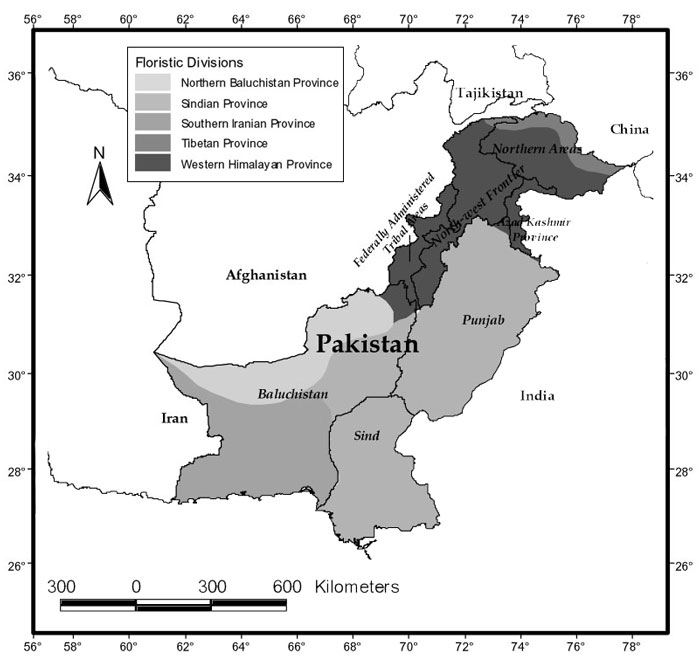
Although established as an independent country only in August 1947, Pakistan occupies a position of great geostrategic and biogeographical importance, bordered by Iran on the west, Afghanistan on the northwest, China on the northeast, India on the east, and the Arabian Sea on the south (Fig. 1). Lying between 23-37° N and 61°-81° E, Pakistan has a total land area of 804,152 square kilometers, about twice the size of California. The altitude ranges from sea level to 8,611 m (at K2, the second highest peak on Earth), and temperature varies from well below zero in the high, glacier-clad mountains to 52°C (125°F) at Sibi in the plains. Mean annual precipitation ranges from c. 50 mm at Nok Kundi in Baluchistan to 2032 mm in the monsoonal uplands of Kashmir (Ali 1978). This great variation in elevation, temperature, precipitation, and other physical parameters has resulted in a diversity of biotic communities, and a relatively rich flora of at least 5,700 species of flowering plants (Ali 1978).
---- Biotic Regions of Pakistan ----
 

Pakistan sits astride one of the major disjunctions in the biota of southern Asia, with the line of demarcation running along the western edge of the Indus Basin and the deep dry upper Indus valley of Kohistan (Frodin 1984). This biogeographic disjunction was the mutual boundary between Boissier's Flora Orientalis (1867-1888) and Hooker's Flora of British India (1872-1897), the two standard floras of the late nineteenth century for Southwest and South Asia, respectively. One of the modern floras of the region, the Flora Iranica, initiated in 1963 by K. H. Rechinger (Vienna), follows this eastern boundary of Boissier's classic work, and so includes Baluchistan and the N.W.F. Provinces of Pakistan. The Flora Iranica does not, however, treat plants of the rest of Pakistan, including the very rich northeastern areas.
Figure 1. Map of Pakistan, showing boundaries of the four provinces (Baluchistan, Sind, Punjab, and North-West Frontier), one territory (Federally Administered Tribal Areas), and the Pakistani-administered portion of the disputed Jammu and Kashmir region (Azad Kashmir and Northern Areas). Shading indicates floristic provinces as delineated by Takhtajan (1986).
The underlying basis of this disjunction has been explored by numerous biogeographical analyses, such as those of Stewart (1972), Zohary (1973), Ali (1978), and Hedge & Wendelbo (1978). Takhtajan (1986), summarizing much of this literature, delineated five distinct floristic provinces that extend into the territory of Pakistan (Fig. 1). Two of these provinces, the Southern Iranian and Sindian Provinces, belong to the Sudano-Zambezian Region (African Subkingdom, Paleotropical Kingdom), which extends west along the southern Arabian Peninsula through the Horn of Africa to eastern tropical Africa and across to the Atlantic coast of Mauritania, Senegal, and Guinea. The other three floristic provinces in Pakistan belong to the Irano-Turanian Region (Tethyan Subkingdom, Holoarctic Kingdom): the Northern Baluchistan and Western Himalayan Provinces in the Western Asiatic Subregion, and the Tibetan Province to the Central Asiatic Subregion. Thus, the source and affinities of the plants of southern and southwestern Pakistan are with central and eastern Africa and the coastal regions along the Arabian Sea, whereas the source and affinities of the flora in northern Pakistan are with Central Asia, from Turkey in the west to the Gobi Desert in the east. In addition, eastern Pakistan has an admixture of elements from the Indomalesian Subkingdom (Paleotropical Kingdom), and in the monsoonal forests in Azad Kashmir, one finds elements of the Eastern Himalayan Province (Eastern Asiatic Region, Boreal Subkingdom, Holarctic Kingdom).
The flora of Pakistan includes no endemic families, and only three endemic genera (Douepia in Brassicaceae, Stewartiella in Apiaceae, and Decalepidanthus in Boraginaceae). In all, there are some 203 endemic species, or about 4% of the flora (Ali 1978). Many of these endemic species are found in the montane regions of northern Pakistan, particularly in the Chitral and Kashmir districts, and in northern Baluchistan. Notwithstanding, these regions are considered to be relatively poorly known and likely to be sources of new species (Chaudhri 1977, Frodin 1984).
---- Conservation & Environmental Issues ----
 

Pakistan has a human population of some 141,500,000 (July 2000 est.), according to The World Factbook 2000 (www.odci.gov/cia/publications/factbook/geos/pk.html). Because some areas of Pakistan, especially the arid southwest (Baluchistan) and the mountainous north, are inhospitable and sparsely populated, this large population is heavily concentrated in the Indus Valley. The environmental impacts of this huge human population and the very long history of human occupation of the Indus Valley (home to a highly developed urban civilization at least 5,000 years ago) present special challenges to the government. Many of the most pressing environmental issues in Pakistan involve water, i.e., water pollution from raw sewage, industrial wastes, and agricultural runoff, and shortages of potable water for a majority of the populace. The other major environmental problems – deforestation, soil erosion, and desertification – are also closely tied to water use and availability.
In order to begin to address these problems, Pakistan needs good information about its natural resources. A Flora based on all available plant collections and on the most current taxonomy and phylogeny of those plants is an essential first step to understanding, managing, and preserving the biodiversity of any area. Because terrestrial communities are generally defined by their plants, a Flora forms the foundation to which inventories of animals, fungi, etc., can be added. Completion of the Flora of Pakistan will provide scientists and government officials with critical information for management of their resources. Because the database resulting from this project will be geographical in nature, it can be used with data on soil types, precipitation, and other parameters to address questions such as what intact habitats should have highest priority for conservation, and what types of plants should be used in restorations for erosion control, reforestation, and the like.
Nasir (1991) conservatively estimated that 580-650 plant species (c. 12% of the flora) are threatened or endangered, but suggested that this number would increase when work on the Flora is completed. He cited habitat destruction, over-exploitation of economic plants, introduction of alien species, and pollution as the major causes for this threat. Nasir (1991), Sulaiman et al. (1991), and others suggest that awareness of the problems is widespread, but that additional knowledge and information is critical if the problems are to be addressed and solutions found.
Many results of the proposed project will have a direct and beneficial impact on conservation efforts in Pakistan. Knowing what species occur where, at what elevations, with what other species, and whether the species is rare, is the type of information that is critical for informing decisions about where to establish conservation areas, how big to make them, etc. The ability to combine data on known collections, soil types, elevations, associated plants, and other parameters will make it possible to identify areas of potential distribution of rare species, or to select appropriate plants to be used in ecological restorations. In a country with limited resources suffering serious problems of deforestation, soil erosion, and desertification (Nasir 1991), the ability to make rapid, fully informed decisions regarding restoration and other conservation projects is extremely important, and depends on sufficient background data.
---- Botanical Collecting in Pakistan ----


Stewart (1972, 1982), Hedge (1991), and others have reviewed the history of botanical exploration in Pakistan fairly extensively. Starting in 1820 with an expedition to Kashmir by William Moorcroft, many European (mainly British) botanists visited Pakistan, eventually collecting plants from virtually all parts of the country. The coverage was modest in the mountainous areas in the north, inhabited by often-hostile tribes and naturally inhospitable as the nexus of the Hindu Kush, Karakoram, and Himalayan ranges. The results of these collecting activities contributed to the two great floras of the region, the Flora Orientalis (Boissier 1867-1888) and the Flora of British India (Hooker 1872-1897). Collecting continued in the early twentieth century, rendering much of those great 19th century floras out-of-date. One important aspect about the collections made in Pakistan prior to the country's establishment in 1947 is that virtually all of them were housed either in Europe (mainly BM, E, and K) or in India, at Calcutta or Dehra Dun, in both cases inaccessible to botanists in Pakistan (Stewart, 1972). The largest plant collection in Pakistan in 1947 was that developed by Ralph Stewart at Gordon College in Rawalpindi.
A comprehensive and accessible flora of this region is essential to our understanding of the plants of south Asia generally, and will be particularly useful in relation to floristic projects such as the Flora of China, the Flora Malesiana, and ongoing work in India and in the central Asian region. Many local Floras exist for parts of Pakistan (Stewart 1982), but these have been superseded by the Flora of Pakistan. The Flora of Afghanistan (Kitamura 1960) is actually a synoptical checklist in format, covering the results of expeditions to the Karakoram and Hindu Kush by Japanese botanists in 1955. A later report from the same expedition (Kitamura 1964) enumerated plants from the part of the region in Pakistan. This region where the Western Himalayas meet the Karakorams and the Hindu Kush in northern Pakistan and the northern Baluchistan region are rich in endemic plants, and many genera of agricultural and horticultural importance occur in Pakistan, yet our knowledge of them and access to information about them is limited at the present time.
---- History of the Flora of Pakistan Project ----


As the new nation of Pakistan began to develop universities and a scientific infrastructure, it became obvious that a first priority in the area of botany would be production of a Flora for the country. In 1960, Stewart retired from active work at Gordon College, and turned over his herbarium, then numbering about 50,000 specimens, to his collaborator Prof. E. Nasir. The "Stewart Herbarium" was later presented as a gift to the nation, and formed the nucleus of the National Herbarium of Pakistan (Ali & Ghaffar 1991). This collection, and those established at other institutions, particularly at the University of Karachi by S.I. Ali, provided the necessary foundation for writing the Flora. During the 1960's, the U.S. Department of Agriculture developed a scheme to use PL480 funds, which had to be spent within the country, to collect plants in Pakistan. That program ultimately did not survive, but the funds were still available and a new proposal was developed. The Flora of Pakistan project was initiated in 1968, with Nasir and Ali appointed as Joint Editors. They set to work immediately, and in 1970, the first fascicle (Flacourtiaceae) of the Flora appeared. Another of the early publications of the project was the "Annotated Catalogue of Vascular Plants of West Pakistan and Kashmir" by Stewart (1972), intended as a preliminary checklist of the plants of the region and a guide to the developing Flora project. Stewart included 5,783 species in his catalogue, and Flora treatments published subsequently have not changed that overall estimate appreciably (Ali 1991), although new treatments for individual genera/ families differ, sometimes substantially, from those by Stewart.
By 1995 the Flora project had produced 197 treatments (one per family), ranging in size from a few pages to nearly 500 pages (Poaceae). Nasir (replaced by M. Qaiser after his death) and Ali or their colleagues and students wrote many of these treatments, while others have been completed by specialists worldwide working with them. Even though the herbaria within Pakistan have developed accordingly, the authors have had to consult extensively with British and other foreign herbaria since they contain large historical collections and the type specimens of most species in Pakistan. The USDA funding supported the publication of most of these treatments, but the PL480 program ultimately came to an end, and work on the remaining volumes needed to complete the Flora since 1995 has been hampered by lack of funding. The total number of species included in the 202 published treatments (see List) is about 4,200, which leaves some 1,500 species in 11 families (c. 25% of the entire flora) still to be treated.
---- The Flora of Pakistan: Current Status ----


In 1999, at the XVI International Botanical Congress, S.I. Ali (University of Karachi and principal editor of the Flora of Pakistan) proposed a plan to Peter H. Raven (Missouri Botanical Garden) for completing the Flora in five years with the Missouri Botanical Garden as co-publisher. Following negotiations, in February 2000, the University of Karachi and the Missouri Botanical Garden signed an agreement to co-publish the remaining volumes of the Flora of Pakistan over a period of five years. This initiative has several strong positive features:
  1. It will complete a Flora of an important and insufficiently known region;
  2. It connects geographically and floristically with the Flora of China project headquartered at the Garden (many taxa in common, often requiring a coordinated approach);
  3. It provides the best opportunity to develop a database of plants for south Asia, which can connect with comparable databases for China and elsewhere and can serve Pakistan as an important biodiversity management tool; and
  4. It will provide a source of new collections from that region, which is poorly represented in American herbaria.
The family treatments remaining to be prepared, comprising c. 25% of the species in Pakistan and some include some notably complex and speciose groups, are as follows (approx. number of genera/species): Cactaceae (2/7), Chenopodiaceae (29/112), Compositae (130/615), Crassulaceae (8/37), Cyperaceae (9/118), Liliaceae (25/63), Myrtaceae (7/13), Polygonaceae (12/110), Rosaceae (26/159), Salicaceae (2/40), and Scrophulariaceae (37/162). Of these, Chenopodiaceae, Polygonaceae, and Salicaceae are in various stages of revision or editing (as of 1/1/2001) and will appear first. Treatments of Compositae tribes Anthemidae (7/89) and Inuleae (23/88), Crassulaceae, and Cyperaceae are in various stages of preparation. The remaining treatments are as yet unassigned, and will be prepared by Ali and/or other authors from Pakistan or abroad. This work will require fieldwork and travel to foreign herbaria (especially such large holdings as BM, E, K, and W) for viewing types and important collections, as well as preparation and editing of treatments. This project calls for collecting expeditions in order to 1) collect material directly relevant to finishing the remaining Flora of Pakistan treatments (especially Cactaceae, Myrtaceae, Liliaceae, Rosaceae, Scrophulariaceae, and Compositae); 2) improve collections from areas of Pakistan that are relatively under-collected, ecologically significant, or particularly threatened; and 3) address specific collecting requests from botanists with interests in the region. Depending on the needs of the Pakistani botanists and institutions, the first two sets of duplicates (and any holotypes) will be left in Pakistan (KUH in Karachi and RAW in Islamabad). Additional sets of specimens will be made available to American institutions and to specialists working on plants of the region. Requests for "special" collections (anatomical, molecular – fresh or in silica gel, living, etc.) will be considered if time and resources allow, and in accordance with any protocols and/or permit requirements established by the Pakistani government.
---- Checklist of the Plants of Pakistan ----


The third "product" intended to derive from this project is the Checklist of the Plants of Pakistan. Just as Stewart's (1972) "Catalogue" was intended to summarize existing data and stimulate new research, so too do we intend for the Checklist to be a stimulus for future work. The format of the Checklist will be similar to that of the recent Catalogue of the Vascular Plants of Ecuador (Jørgensen & León 1999) and will present a synopsis of the entire flora of Pakistan. For each accepted name, this format will include author and citation, synonyms, abbreviated distribution statement, one verified voucher (and/or the type specimen, if from Pakistan), and references to major literature on the taxon. Introductory chapters will briefly summarize information about Pakistan's geology, paleoclimate, geography, climate, vegetation, and history of exploration. It will be based on the Pakistan Database, and will be available both electronically and as a published volume. However, all treatments will be reviewed and compared with current taxonomy and nomenclature, especially by reference to treatments in Flora Iranica, Flora of China, and recent monographs. Whenever possible, the family treatments for the Checklist will be sent to specialists for review. This type of revision will be particularly important for fascicles published early in the Flora project, and for groups in which current research is particularly active.

---- Database Development ----


The database for the Flora of Pakistan project is being developed on the same model as that for the Flora of China project (http://flora.huh.harvard.edu/china). Ali and colleagues will provide the remaining treatments (starting with Iridaceae) as Word documents, which will be parsed (paragraph-delineated) and converted into an Excel database. All earlier treatments will be scanned using an optical character reader (OCR) and saved as Word documents, edited for accuracy against the original, parsed, and converted. Each element of the Flora treatments – family descriptions, notes, and keys; generic descriptions, synonymies, notes, distribution, and keys; and species names, place of publication, types, synonymies, notes, indigenous uses, distribution, phenology, cited specimens, and illustrations – will be included in this interactive database. Ultimately, users will be able to search the database using a variety of queries. More than half of all species in the Flora of Pakistan are illustrated, and these drawings and photographs will be scanned and made available electronically.
The specimens cited in the Flora of Pakistan, which include full available label data, are arranged according to a grid system (see map in DATA, which is included at the front of each volume of the FOP) rather than by province or district. Each grid unit corresponds to a "square" measuring 2° on each side. As a result, every cited specimen can be mapped to within 1° accuracy by using the central point in each grid unit, even though very few include latitude/longitude readings. So a specimen listed as "D-5" (corresponding to 30°-32° N/68°-70°E) can be mapped to 31°N/69°E. Eventually we intend to have coordinates for all localities in Pakistan, but until that system is in place, we already have a geographical basis for the database. The main database will be housed at the Missouri Botanical Garden as it is being constructed, and the web site will reside on a Garden server, at least initially. As soon as the University of Karachi has the capability to host the site, a mirror site will be installed there, making the information much more readily available in Pakistan and the surrounding region.
farming.com.pk. Powered by Blogger.